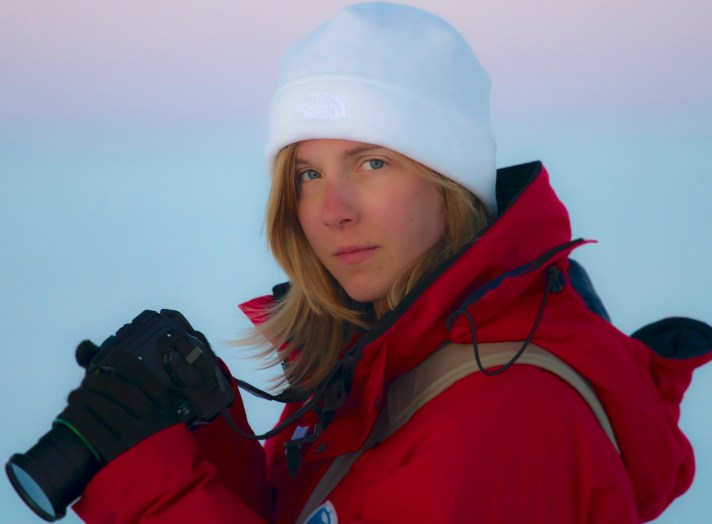
I am a postdoctoral researcher at the Littoral Research Chair (Université Laval, Quebec City, Canada). I hold a Ph.D. in Natural Resource Sciences (McGill University, Montreal, Canada), and a B.Sc. and M.Sc. in Biology (Université Laval). My applied research investigates marine ecosystems under climate change in the Arctic, and the implications of ecosystem change for fisheries, food security, health, and wellbeing of coastal Indigenous communities. My approach to research is collaborative, bringing together different ways of knowing throughout the research process. I am also an eager science communicator, sharing my research through articles, conferences, podcasts, short films, interactive workshops, and new media, in English and in French. I am highly engaged in initiatives aimed at improving equity, diversity, inclusion, and decolonization in academia, for example contributing to putting together an Arctic research code of conduct aimed at making northern research safe and inclusive for all.
I am a polar enthusiast: I am fascinated by everything that relates to the Poles and I love sharing my passion with the public. I have worked in polar sciences for over a decade, including as part of expeditions onboard the research icebreaker CCGS Amundsen across the Canadian Arctic, at the scientific base Dumont d’Urville in Antarctica, and within community-based research programs in Inuit Nunangat. I’m also quite an adventurer, passionate about mountaineering, backcountry snowboarding, scuba diving, and trail running.
Twitter: @Marianne_Fa
Website: http://mariannefalardeau.wixsite.com/polar
Twitter: @Marianne_Fa
Email: marianne.falardeau-cote.1@ulaval.ca
Website: http://mariannefalardeau.wixsite.com/polar
List of articles:
Selection of research outputs:
Falardeau, M., Bennett, E. M., Else, B., Fisk, A., Mundy, C. J., Choy, E. S., Ahmed, M. M. M., Harris, L. N., and Moore, J. S. (2022). Biophysical indicators and Indigenous and Local Knowledge reveal climatic and ecological shifts with implications for Arctic Char fisheries. Global Environmental Change, 74, 102469. https://doi.org/10.1016/j.gloenvcha.2022.102469
Falardeau, M., & Bennett, E. M. (2020). Towards integrated knowledge of climate change in Arctic marine systems: a systematic literature review of multidisciplinary research. Arctic Science, 6(1), 1-23. https://cdnsciencepub.com/doi/10.1139/as-2019-0006
Falardeau, M., Raudsepp-Hearne, C., and Bennett, E. M. (2019). A novel approach for co-producing positive scenarios that explore agency: case study from the Canadian Arctic. Sustainability Science, 14(1), 205-220. https://doi.org/10.1007/s11625-018-0620-z
This last paper presents a new approach that I propose for participatory scenario planning within Arctic Indigenous contexts. We wrote a plain language report on this project:
Falardeau, M., Raudsepp-Hearne, C., and Bennett, E. M. (2019). Hivunikhavut – Our Future. Scenario report, McGill University eScholarship institutional digital repository. 36 p. https://escholarship.mcgill.ca/concern/reports/s1784q70d?locale=en
I also produced a film on this project, called ‘Hivunikhavut – Our Future’ available on YouTube: https://youtu.be/ch7mW9eUqms?si=XOirTr6Qd1WgOS-S
The full citation for the Arctic research code of conduct: Ropars, P., Devoie, E. G., Falardeau, M., & Thompson, L. (2023). Arctic Research Code of Conduct. Quebec City, Canada: ArcticNet Inc.


 Women in the Arctic and Antarctic